Friday, January 16, 2015

How can you save the Earth?

I'm sure "global warming" is the expression that you heard more than million times in the last couple of years. It is very serious problem that already started to affect our lives. Have you even seen snow this winter? When I was a kid (and that wasn't so long ago) Winter started around December and lasted until March. There was snow everywhere! I would go sledging, skiing on real snow, not artificial as it is made today or just enjoy walking through the town while it snows.


just let this sink in

The problem is, that many people don't seem to be aware of the severity of the problem. Many of them are concentrated only on how will they live tomorrow, instead of looking at the whole picture, in other words, how will their future in a few decades look like and the future of future generations?
And what about animals, and plants? They are not destroying the nature and its balance, but are suffering consequences because of us.Are you really willing to risk everything we created so far? Don't you feel guilty, that there are categories for animals such as: endangered, critically endangered, vulnerable an so on? There's no one to blame for this problem but us. Sadly, this is truth. 


Take situation into your own hands!

In Austria, people are truly conscious about the global warming, but there are way too many countries around the world that are just ignoring the problem. So, to anyone who reads this, if you do thing that are listed down and suggest your friends and family to do same, maybe be still have a chance to save the Earth.


1. Spend water consciously!
Turn the tap off when you brush your teeth. Think about people who don't have enough water or is contaminated and think about consequences of wasting water. Today, you're wasting it, and tomorrow you'll have to pay higher bills for water or might not have water at all.  If you have a leaky pipes or toiler, fix it immediately. 


2. Walk or ride a bike!
A lot of families today have one or more cars that they use on daily basis, even when there's no need for that. If you have to go to the store, take your dog for a walk with you instead of driving there by car. It is good for your health and environment, because you reduce emission of greenhouse gases and burn calories at the same time. 


3. Turn off lights!
Come on, this is not so hard and at the same time, you save energy and your money. Whenever you leave the room, turn it off. If you're working on a computer use just table lamp, not 10 others in the room. And use compact fluorescent light bulbs (energy-saving light bulb), that waste less energy than normal ones. 


4.ENERGY STAR
When you buy new appliances, computer products and peripherals, make sure they're labeled with "Energy star", because these devices use 20 - 30 per cent less energy.


5.Recycle
It would be good if all countries around the world would at least divide paper, plastic and glass from organic trash. It takes you a second to open a different trashcan.


For the end, I am leaving you with something to think about.

This is very old, Native American saying:


Monday, January 12, 2015

What a good blog looks like?

My task in this post is to explain what a good blog looks like. This seemed easy at first, but as I started reading all kinds of blogs I must admit it seemed a more challenging task.Even though it is hard to give an answer to this question, because every person who reads this blog has a different way of thinking an attitude, I hope I can give a satisfying answer. 


What’s good and what’s not?

First impressions are what it’s all about. The title of a blog is basically one of the first things you notice and pay attention to when you open a blog: it must be original and intriguing. Posts should be connected to the title with small digressions. The background shouldn't be too loud so that it literally hurts the reader’s eyes as he/she reads posts and there should be a connection between the content of the blog and its background. For example, who would like to read a blog dedicated to animals with pictures of cars and motors in the background and a very garish color used for text? No thanks.


Text it should be divided into paragraphs with pictures or videos in the middle (in my opinion this is highly recommended as it increases the readers’ interest) and not written as one big, never-ending brick. It is not attractive at all when you have to read long text which is not divided and therefore unorganized. Even if the topic is well know to the audience, make it interesting and don’t just repeat facts everybody knows. The font should be, above all, legible and shouldn’t look like it’s handwritten as this is hard to read. Something  I really don’t like is emoticons. I know people use them more on forums, but some of them use them on blogs as well. The thing I don’t like about them is that they look, (again, this is just my opinion) very informal. When a person puts about ten smileys one next to the other it just leaves me cold and I lose interest in continuing to read a post. I don’t see the purpose of the excessive usage of emoticons. When a person is a professional blog writer, for example a writer of a travel blog, he or she should avoid posting private pictures that are irrelevant in the post. Even if blog is informal, the register should be polite. Bloggers should post regularly in order not to their readers’ interest.


What about my blog?


This is my first blog so I am not too familiar with "blogging". I am trying to cover topics that are not only interesting to me, but to others as well. Therefore, topics may vary from sport to history or everyday discussions. This is also good practice to improve my knowledge of English. Even though, the correct grammar and appropriate choice of words is my goal, I still struggle to perform these two tasks correctly. After reading about a certain topic on various websites it is hard to sum them up in my own words and a literal translation from Croatian is a mistake I make all the time yet I cannot escape from this.

One day, I would like to travel the world and have my own travel blog where I could post pictures of places I have been and write enthralling stories about the journey. It is more joyful to post your own pictures you made along journey than to upload a picture from "Google". I would also like to write posts on more languages and make it suitable for a wide range of readers. Hopefully, I will run my own blog dedicated to travelling without any grammar mistakes in any of the languages used.


What makes these blogs good?

This is my absolute number one blog from WS13. What attracted me the most is the "flip card" layout with intriguing pictures and useful titles. It has good tips about writing, strategies about learning a language and posts dedicated to travelling. It is well written and easy to understand.

I chose this blog as second on my list of the "Top three blogs of WS13" because it is, without a doubt, entertaining and educational. Once again it covers my favorite type of blog and that is the "travel blog". The great choice of pictures that support every post attracted my attention for reading a certain type post.

Last, but not least, is this blog. The background is just amazing and you can immediately see what this person mostly blogs about and what her interests are. Her posts are updated regularly. Every topic is supported with pictures, videos and links.


To sum up, make sure everything is well connected in your blog and make it interesting, legible and polite no matter whom your targeted audience is. Even if you have wide range of interests, do not join all of them in one post. Pictures and videos are highly recommended.
My role models for a good blog are travel blogs I hope I will have the opportunity to run my own one day.

A list of blogs I find interesting:
http://blogs.discovery.com/animal_news/ (if you are an animal lover this one is perfect for you)
http://www.missedinhistory.com/blog/ (seriously, why don't we learn about this in schools?)
http://discoveramerica.tumblr.com/ (I am thinking about going here for a semester or two)
http://coloursoftheworld.tumblr.com/ (You won't find text here describing these pictures, but you can enjoy the breathtaking nature on them)
http://www.thepolyglotdream.com/ (heaven for a language learner)

Sunday, January 11, 2015

Struggles of being a student

No matter who you ask about the best part of life, everyone will say "student life".
Students, of course, strongly neglect this statement, because they haven't experienced life the way that older people have.

Things that trouble students

Lot of students left their homes and moved in new cities. They either found a small flat or place in student home and finally, they have their freedom. Sweet freedom, where you wash the dishes whenever you want (or don't, it's up to you), where if you come home next day around noon, you won't be grounded, where you do whatever you want to do. You can meet friends whenever you want and skip lunch, eat junk food without hearing criticism from your parents. Ouh, it sounds too good to be true, right?
We all know that behind this life we've always wanted to live are many problems.
Firstly, shortage of money. Parents pay for your living (place, bills, food) and that's a lot of money. As a student you like to party and drinks and food are not free. You know you can't ask parents for more, but you also really want to go to the party. Secondly, as semester is progressing, your duties also progress. You have to study harder and spent more time reading than being couch potato or sleeping all day. If you haven't done anything but partying all semester, you won't have a nice time when finals start to kick in. 


Thirdly, fear of failing. University is hard and you really have to want it to succeed. It's not high school and people expect great things of you. Your entire future depends on this. Your parents expect from you that you finish college and find a job, help out a family. And when you have all that in mind it is not very easy to focus on studying, because you know the significance of passing an exam. 
Lastly, as Mark Twain would say: "The more I learn about people, the more I like my dog." While you're on university, you'll meet a lot of people. You'll probably get more disappointed than satisfied and happy. You'll meet more people you'll want to run away from than to spend time with them. You'll see what kinds of people exist and that will give you an experience for life. 

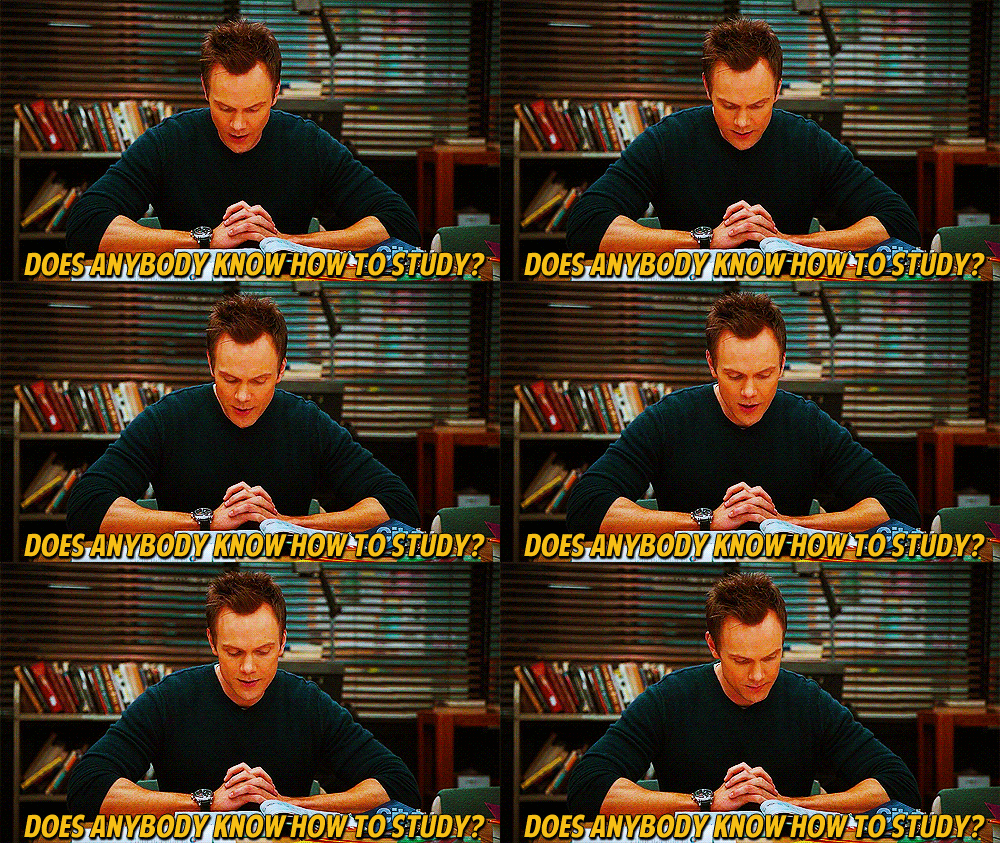
Finals be like

Wednesday, January 7, 2015

Sorry, you got the wrong end of the stick, again!

Q: "What is most widely spoken language in the world?"
A: "Bad English"


Even though this is a joke, it is also not far from truth. Sadly, too many people these days underestimate the complexity of learning a language, especially English. "English" we learn in schools is quite the opposite of what English actually is.
It is enough for communicating about everyday stuff or for asking for directions if you're in a foreign country. People will understand what you are saying, but will you understand what Americans or Britons are telling you?


Let me give you an example:
You have a survey on whether people like horror or action movies more.
If you come across a stranger, he will probably say something like:
"Action movies are, in fact, my favorite. Horror movies, on the other hand, are too unrealistic for me and I don't like them". 
Perfect,you understood what the person said and you can continue with your survey.
An English native speaker will say something like: " Horror movies leave me cold and action movies are not my cup of tea." Hmm, does that mean that this person watches horrors tucked up with few blankets because the temperature get lower as movie is coming to an end? And what does tea have to do with action movies? Any suggestions?


Even though, the grammar is not very complicated, it's the phrases and hidden meanings behind them that give people hard time understanding the language. If you change only one adverb in phrasal verbs, you will get totally different meaning. For example, make out means to see or discern something, especially with difficulty. Make up means to compensate for. It is maybe easy to learn a difference between theses two phrases, but there are numerous phrases that are written in the same way, but have different meanings. Let's take make out for as an example. Firstly, it can mean to see or discern something, especially with difficulty. Secondly, it can mean to hear something well enough to understand it. Thirdly, it can mean to achieve a particular level of success.
(sourcehttp://idioms.thefreedictionary.com/make+out)
Here are only few out of many different meanings this phrasal verb has. My point is, that it is very easy to get the wrong end of the stick while talking with English native speakers. Therefore, be careful and read carefully and conscientiously. If you didn't understand what the person told you or if you hear something that sound like a metaphoric phrase, ask. Don't just nod your head as you'll never improve.


Thankfully, the Internet is full of useful sites that can help you improve your English. So, if you don't feel confident about your English, I recommend you use these helpful sites on a daily basis. You can hear news every day on a different accent, you can read and write and have fun throughout.

List of useful links:


Dictionaries! Please, check if you're not sure about a certain word.
Cambridge Dictionary
Merriam-Webster
Longman Dictionary
Oxford Dictionary
Vocabulary.com

TED talks (short presentations with clear pronunciation and very interesting topics)
Missed in history
How stuff works?
English for those who already speak it 
Hogwarts is here (Finally, for all HP fans, here's a website where you can actually learn all the subjects from HP, but most importantly, you read books and write essays and you also get grades. Explore it on your own, I won't spoil it for you)


Monday, December 29, 2014

The Internet - good or bad?

It is generally known that the Internet has made our lives easier and I agree completely, but has anyone ever thought of all the bad consequences that come along? For example, people no longer spend time together as they used to. Children are exposed to negative impact of the Internet and its users without knowing the severity of danger. Teenagers and many young people who cannot live without playing online games and, in many cases, become addicts.

On the one hand, the Internet is very cheap and easy way of trading things and information. These days it is almost unimaginable to come home and not check your e-mails or news online. Internet has changed the way people live. It is true that many people, mostly older ones, still buy newspapers and magazines, but more and more young people read everything on the Internet. It is possible that newspapers will be replaced by online news, which are, in comparison, free and convenient (just imagine what it's like walking to the first news-stand and it's minus 10 degrees Celsius outside.) Another very important thing that made the Internet an everyday habit is the wide range of services it offers. You can easily buy from your favorite shop without leaving your armchair. You can sell stuff you don't need anymore as well, for example, clothes or toys on the condition that they haven't gone to rack and ruin. It's very efficient and easy way of trade. If you volunteer in a camp or go on a concert in another country and meet great people, you will definitely want to stay in touch with these people; and what easier than communication via Skype? You can not only talk with them, but see each other too. Great way of practicing foreign language. Few decades ago, this was improbable to become part of everyday communication. 


On the other hand, with great power comes great responsibility. Having said that, I mean that every user of Internet should behave properly and decently, without putting down or insulting other people just because they have different way of considering things. Young children, who are easy target to manipulate with because they are naive and inexperienced, should be controlled by their parents and not left alone. They should be taught in schools how to use the Internet and how to behave while using it so that in future number of people doing harm to others is declining. Even though, you can chat with your friends while playing online games, nothing can replace face-to-face communication. Meeting your friends for a coffee and talking with them, laughing or going for a walk cannot be compared with communication via the Internet. It will be great if people would meet more in person than on the Internet, but based on the rapid growth of value that Internet has in today's world, I think it is going the opposite way.


To sum up, with all its helpful and convenient features, the Internet still cannot replace face-to-face communication and it is a threat for inexperienced people, which can cause grave consequences.  

Tuesday, December 23, 2014

What do you know about the longest international border in the world?

I know we all had geography in our schools, but there are some thing you cannot find in school books. I accidentally came across this topic and wanted to found out a bit more about it. The U.S. is third biggest country in the world and it has one of the longest borders in the world.

Let me tell you about the international border between Canada and the U.S. It is the longest border between two states in the world with 5,525 miles long (about 8891 km). It overlaps with 49th parallel north, but it is NOT straight as it should have been. Cartographers drew a straight line on the map, but the engineers built it zigzag, unintentionally of course. It was the 19th century so the only equipment engineers had was a compass and a ball of string. They built 900 monuments along the straight part of the border, and about 8,000 monuments in total. Due to several treaties over the years and in order to solve animosity caused by following the watershed as border between these two states, both countries agreed on simpler solution: 49th parallel. U.S. gained more territory than Canada in this last treaty that shaped the border.


“Don’t touch me”, said Canada. “I won’t”, said the U.S. So, they moved 20 feet apart.

They did exactly what is stated in this sentence creating a 20 feet (approximately 6 meters) of deforested straight line that follows the entire length of the border (known as “no-touching zone”). There are no trees in this zone, and the new ones that start to grow are immediately cut off.  There are also some unsolved territory issues, especially in the Atlantic Ocean. Canada and the U.S. both claim that these specific islands are part of their territory and can’t really solve this problem, but luckily this doesn't  cause big problems so far.


This straight border caused more problems as it was moving westward. For instance, on the western coast in the Washington state Point Roberts is not connected with the U.S. as there is a border and Canadian territory between them. This area is home to thousands Americans, but has only primary schools. Needless to say, students must cross a border few times a day to get to their high school.


I highly recommend to see this video, it is amazing: 


This is an interesting link I found about fascinating borders in the world: http://www.buzzfeed.com/austinhunt/22-eye-opening-international-borders-from-around-the-world#.cpJV3n7oM

All in all, it is a very long border and there are some problems that will hopefully be solved in the future. I hop you enjoyed this post.

Monday, December 22, 2014

Education in the U.S.

Whenever I met someone who doesn't live in Croatia, one of the first topics I talk about with this person is educating system in his or her country. For example, In Germany they must learn Latin for six years including reading Caesar's books, translating them and writing whereas in Croatia we have Latin for two years and learn grammar, quotes and words that appear in our books. In Scotland, high school is called Academy whereas in Croatia Academy refers to higher level of education where person gets a degree in arts. In France they have up to seven mandatory subjects they can choose on their own whereas in Croatia, in gymnasium, you have up to 16 mandatory subjects. As you can see, education systems vary from country to country. What interests me lately is American education system about which I did a little research and would like to present you.


In the U.S. children can go attend public schools, private schools (privately funded) and can be home schooled. Officially, compulsory education starts at the age of 5, but children can attend pre-kindergarten. At the age of five children start attending elementary school that lasts 6 grades if school follows "6-3-3" plan. This plan means that elementary school has six grades (finished at the age 12), junior high school or middle school lasts from grade 7 to 9 (finished at the age of 15) and high school that lasts from grades 10 to 12. In every state students must take "Standardized tests" every year in which they must show improvement and  reach a minimal education level. Education is compulsory for all students until they are 16 years old and can drop out of school and find a job, but the chances of finding a good job are smaller than for students who finish their high school completely. After graduating from high school students can choose from various colleges that offer undergraduate degrees (associate's degree or bachelor's degree) and universities that offer bachelor's degrees, master's degrees and doctorates. It is common for high school graduates to take a gap year before they go to college for travel or work. 


What is common in the U.S. is school bus which is typically designed for student transport. School buses are painted yellow because it is color most easily seen in the dark. Buses are specially equipped with safety devices and used for transport from student's homes to schools. More than half of the student population is transported by school buses.

In my opinion, every country's educational system is different in some way or the other, but I think the U.S. has the most unique system of them all. You are free to leave comments on this post.